Re-thinking the physical store
Brick, mortar, and mobile commerce
It’s dusk when you pull into a shopping center parking lot and carefully put your mask on. You dial a phone number on your mobile and describe your car’s make and model. A few minutes later, someone wearing a mask approaches your car. You pop open the trunk and make eye contact via the rearview mirror. They put something in your trunk, signal for you to close it, and wish you a great evening. You drive off.
This isn’t a scene from a spy movie.
Big-box retailers get to quote Mark Twain a lot these days: “The report of my death was an exaggeration.” Curbside pickup has emerged as a clear differentiator and a great value-add this year during the pandemic. It has also helped to significantly pad retailers’ bottom lines: Target, for example, is adding nearly 8,000 drive-up parking spaces to its stores, with each location gaining up to a dozen. It announced that Q2 same-store sales grew nearly 25% – an all-time high that blew away the 7.6% increase expected by analysts – partially on the back of its curbside pickup sales, which soared 700%. (This is not a typo.) It’s not alone: By August, Walmart had doubled its e-commerce sales and introduced a new membership program similar to Amazon’s Prime. (It seems that Walmart hired whatever branding agency was used by media companies to name their own streaming offerings, because they landed on a rather uninspiring Walmart+.) Home Depot and Lowe’s also saw double-digit growth. The investments that big-box stores had already made in digital commerce infrastructure created an instant advantage – especially for the ability to shop in stores without interacting with others and the flexibility to pick up purchases from a physical location. What unlikely champions.
Curbside pickup was initially called BOPIS (buy online, pick up in store), which is pronounced exactly how it looks and should be a perennial contender for the world’s worst acronym. We suspect it received this terrible name because it seemed like something that would never catch on. Oh, but catch on it did. Adobe’s most recent Digital Economy Index gives a nice visual of how drastic the YoY change has been:
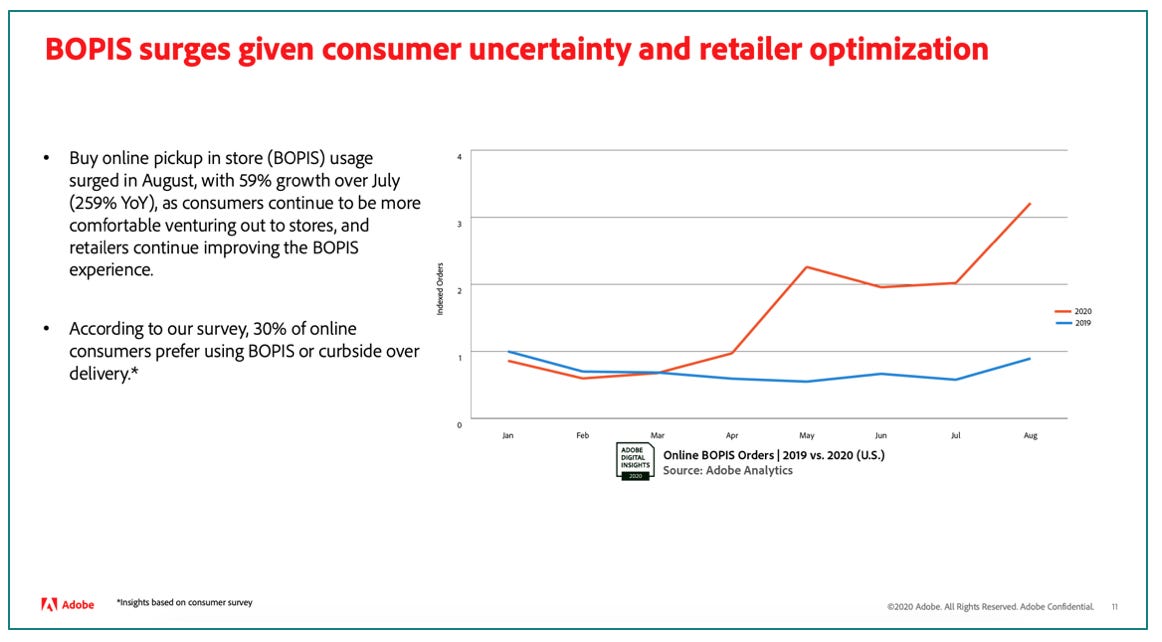
The good perhaps outweighs the weird. Whenever there’s a new challenger rising against an incumbent – in this case e-commerce vs. traditional brick-and-mortar retail – there is a temptation to compare the two as if they’re parts of the same pie. In some ways they are: For some consumers, e-commerce channels have completely overtaken their shopping habits, and the thought of going back to a store may cause them to break out in hives. For others, the curation that good stores offer in a world of abundant products and options is seen as a welcome shortcut through what could be hours spent researching, reading comments, and generally sweating decisions that ultimately aren’t very consequential. Will a slightly better toaster that you’ve spent days researching improve your quality of life significantly? I hope not. The missed opportunity here is to think through how one might enhance the other: In other words, could the challenger improve, rather than outright replace, the incumbent?
Indeed, these two commercial models aren’t mutually exclusive. Research and projections from eMarketer show that once the current spike in e-commerce reconciles with a total reduction of retail activity, we’re likely looking at a very even-keeled “e-com makes up 15-20% of all retail sales” pace over the next several years:
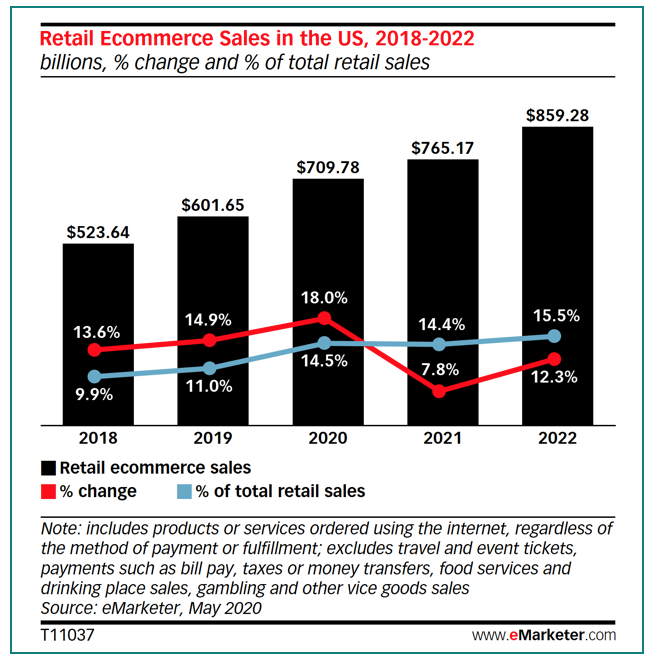
Turns out consumers can (and do) like both retail modes. Digital commerce is better for research, discovery, and frictionless payment options, while retail commerce may be easier for pickup logistics and ensuring that you can see the products you’re buying IRL. The way you buy groceries every week doesn’t have to be the same way you buy a couch or jewelry.
Contrast that with the old way and old assumptions about what shoppers care about. For example, Sparrow HQ recently needed to buy a new laser printer fairly urgently. Our admin read the printer recommendations from Best Buy, identified the model she wanted to purchase, and searched for it locally. It popped up at a local store, with a “buy online, collect in store” option that came with a catch. The retailer made the buying experience seamless, but it was easy to miss the fine details about how the printer couldn’t be picked up in store until five days later – three days longer than it would take to ship the same item, from the same retailer – directly to Sparrow HQ.

This underscores how retailers’ outdated models for surfacing, sourcing, and marketing products conflict with consumer expectations and how they narrow down what and where to buy things. While Best Buy had the most effective ads, the retailer ultimately couldn’t get us what we needed when we needed it. When analyzing data post-campaign, this might look good, a success to the ads team; the commerce team will be left trying to interpret an abandoned cart and the hit to loyalty incurred by this experience.
Today, it’s all about holistic customer experiences (CX), not specific channels. There is room for both direct-to-consumer and traditional retailer brands to win on this new playing field, but only if they obsess over CX and prioritize it above all else – a different playbook from those that perpetuate outdated assumptions from the ‘90s and heyday of suburban shopping malls. Instead, the path to customer loyalty is paved with options and flexibility. Customers want to return items they bought online to a store without a hassle. If they were finally going to pull the trigger on a pricey pair of yoga pants in-store, but their size is out of stock, they appreciate being able to order them from another store. And while many assume that customers always want to receive their orders as quickly as possible, many would prefer to have a modicum of control over delivery and choose a day or destination that is most convenient.
Some examples of new(ish) blended e-commerce + brick & mortar retail experiences worth highlighting:
Removing payment friction: The in-store checkout experience, with its snaking lines and perpetually disappearing checkout employees, has been so ingrained in our collective psyche as a necessary part of shopping – almost like Blockbuster’s late fees. Apple stores challenged that outright with the introduction of roving employees who could check you out with their handheld checkout devices and send you on your way in no time. The introduction of Easy Pay, with the launch of iPhone 4 and 4S back in 2012, expanded that concept by allowing customers to use their own mobile devices to check themselves out. Nowadays, Apple Pay is everywhere, as are all manners of self-checkouts, all the way through to fully automated stores, such as the cashier-less Amazon Go concept.